Showing posts with label Jim Holt. Show all posts

Sunday, December 5, 2021

Reflections on Jim Holt's When Einstein Walked With Godel: Excursions to the Edge of Thought

When Einstein Walked with Godel: Excursions to the Edge of Thought is a collection of 24 full length essays plus several shorter pieces written by Jim Holt, the author of the thought-provoking 2013 book Why Does the World Exist? Holt discusses a wide range of subjects that relate to at least one of three categories: "our most general conception of the world (metaphysics), how we come to obtain and justify our knowledge (epistemology), and even on how we conduct our lives (ethics)" (p. x). 

When Einstein Walked with Godel: Excursions to the Edge of Thought is a fascinating book. I will not review each essay, but I will single out a few of my favorites to whet your appetite to read them all.

The book begins with the title essay. It is a fun fact that two of the greatest geniuses of all-time regularly took walks together, and it is touching that Einstein once said that he went to his office at the Institute for Advanced Study "just to have the privilege of walking home with Kurt Godel." I don't take Einstein's statement as false modesty--like most, if not all, geniuses, Einstein was quite aware of his capabilities--but rather as a genuine statement of affection and admiration for his friend Godel. 

Einstein and Godel were not only geniuses but also--regardless of the fame and acclaim that both received--outsiders. Holt notes that after Einstein initially failed to receive his doctorate in physics he gave up on pursuing an academic career, declaring "the whole comedy has become boring." Einstein worked as a patent clerk, but he followed closely the scientific questions of the time, and he read with interest about what Henri Poincare termed the three greatest unsolved questions: (1) the photoelectric effect, (2) Brownian motion, and (3) the nature of the "luminiferous ether" which had yet to be detected experimentally but was supposed to be the medium through which light waves traveled. Holt explains, "Working alone, apart from the scientific community, the unknown junior clerk rapidly managed to dispatch all three" questions in a series of papers published in 1905, when Einstein was just 26 years old (p. 5). Einstein received the 1921 Nobel Prize in physics for his work on the photoelectric effect, but his equation E=MC2 forever transformed our understanding of space, time, and energy.

Einstein had already finished most of the work for which he would be most remembered prior to Godel's birth: "In 1906, the year after Einstein's annus mirabilis, Kurt Godel was born in the city of Brno (now in the Czech Republic). Kurt was both an inquisitive child--his parents and brother gave him the nickname Herr Warum, 'Mr Why?'--and a nervous one. At the age of five, he seems to have suffered a mild anxiety neurosis. At eight, he had a terrible bout of rheumatic fever, which left him with the lifelong conviction that his heart had been fatally damaged" (p. 8).

Godel developed two incompleteness theorems that had profound implications for mathematics and epistemology. The first incompleteness theorem is that no logical system can capture all the truths of mathematics; within any mathematical system there will always be at least one statement that cannot be proven or disproven within that system. The second incompleteness theorem is that no mathematical system can be proven, within its own devices, to be free from inconsistency. When Godel first presented his theorems, few people understood them, and some of the people who understood vigorously objected because they disliked the implications about the nature and limitations of knowledge.

The nature of time is one of the subjects that Einstein and Godel discussed. For Einstein's 70th birthday, Godel presented to him a gift: a solution to Einstein's General Relativity equations demonstrating the theoretical possibility of time travel in a rotating universe. Einstein did not like the idea of a rotating universe in which time travel is possible, but he found no flaws in Godel's math. Holt notes that Godel presented the solution as proof that, in Holt's words, "time itself is impossible. A past that can be revisited has not really passed. And the fact that the universe is expanding, rather than rotating, is irrelevant. Time, like God, is either necessary or nothing; if it disappears in one possible universe, it is undetermined in every possible universe, including our own" (p. 13).

The unanswered and perhaps unanswerable question is that if time is impossible then why do we feel its passage so intensely and so vividly? That question leads to other unanswered and perhaps unanswerable questions. Is everything that we consider to be real and to be meaningful an illusion, or a collective delusion/hallucination? If so, what is the purpose of such a grand deception?

Einstein and Godel could not answer those questions, but that did not stop them from walking, talking, and thinking together.

"The Riemann Zeta Conjecture and the Laughter of the Primes" begins with a discussion of the "Copernican Principle": the "Copernican Principle," first formalized as a mathematical equation by astrophysicist J. Richard Gott III in 1993, postulates that at any given time we are not privileged observers of an event, which in simple terms means that when you see something you are not in the first 2.5% of observers and you are not in the final 2.5% of observers. In other words (to borrow Holt's example from pp. 36-37), if you are attending a play that has had n showings then there is a 95% chance that the play will have no more than 39 x n showings and a 95% chance that the play will have no fewer than n/39 showings. Something that has already existed for a long time is statistically more likely to continue to exist for a long time than something that has only existed for a short time.  

Holt demonstrates that laughter and numbers are things that we share with species who have a common ancestor with us several million years ago. Since laughter and numbers have already existed for millions of years, based on the "Copernican Principle" it is more likely than not that laughter and numbers will exist one million years from now. 

What is the Riemann Zeta Conjecture and what does it have to do with any of this? The Riemann Zeta Conjecture is a hypothesis about prime numbers. If Bernhard Riemann was correct, then prime numbers have a hidden harmony, but if he was not correct then the provisional proofs of thousands of theorems "conditioned" on the correctness of his conjecture will be falsified and, as Holt puts it, "the part of higher mathematics that is built upon it will collapse" (p. 43). In layman's terms, the distribution of prime numbers seems at first sight to be random, but Riemann suggested that when one considers the full (i.e., infinite) set of prime numbers then order emerges from what looks to be chaos. The Riemann Zeta Conjecture has been one of the great unsolved math problems for more than 160 years. Applying the Copernican Principle, Holt suggests that there is a 95% chance that it will be solved within the next six millenia. Holt further argues that once the secret of prime numbers is understood then mathematics will be revealed to be, as Bertrand Russell proposed, "as trivial as the statement that a four-footed animal is an animal." Or, put another way, Holt believes that laughter has a better chance of being an integral part of human existence a million years from now that mathematics does. One could object that his opinion is based too much on speculation, but if you read the entire chapter you will be intrigued even if you remain skeptical.

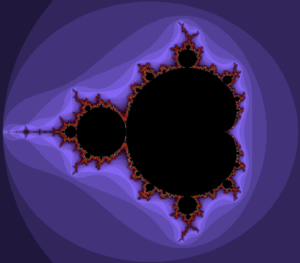
In "Benoit Mandelbrot and the Discovery of Fractals," Holt, in his typical engaging style, describes Mandelbrot's eventful life, and Mandelbrot's inquisitive spirit that enabled him to find order where others saw only disorder and chaos. Benoit Mandelbrot discovered the Mandelbrot set, and demonstrated that things that had been thought to be rough or chaotic--such as clouds and shorelines--actually have a "degree of order." Mandelbrot coined the word "fractal" (derived from the Latin word for broken) to describe self-similar forms, phenomena that are visible not only in physical objects such as clouds and shorelines but also in the behavior of financial markets. Orthodox thinkers in both mathematics and economics bristled at Mandelbrot's ideas but Mandelbrot was stubborn and undeterred.

Academic tenure eluded Mandelbrot--or he eluded it--until he was 75, but his unorthodox way of thinking about mathematics found a home for many years at, of all places, IBM; for a lengthy period of time, the computer manufacturing giant decided to fund pure research. "We can easily afford a few great scientists during their own thing," the director of research told Mandelbrot (p. 98), and those words were music to Mandelbrot's ears. He worked for IBM from the late 1950s until 1987, when IBM decided it no longer wanted to pay great scientists to do their own thing. Six years later, IBM posted $8 billion in losses, at the time the largest such total in U.S. corporate history. Did IBM stop funding geniuses because it ran out of money, or did it run out of money because it stopped funding geniuses?

Fractals are not only beautiful to observe, but they exist at the nexus of science, math, and art. Here is an example of a fractal:
xoasjs

"The Ada Perplex: Was Byron's Daughter The First Coder?" methodically debunks attempts to elevate Lord Byron's daughter Ava from a person who struggled to learn basic mathematics to someone who supposedly was a pioneering scientific figure. It is important to give proper credit to anyone--man or woman--whose accomplishments merit recognition, but it is dishonest and harmful to rewrite history for the purpose of heaping honor on an individual who is not worthy of such recognition. Holt's effort to set the record straight is important, and hopefully will not only result in a widespread reassessment of Lord Byron's daughter but also inspire a thorough and thoughtful examination of other historical figures who are given too much--or too little--credit.

Holt's curiosity, smooth writing style, and active engagement with any subject that he tackles would probably enable him to communicate engagingly even about uninteresting subject matter, but it is a treat to read his writing about the fascinating subjects briefly described above, as well as the other topics addressed in When Einstein Walked with Godel: Excursions to the Edge of Thought.

Further Reading:

Albert Einstein the Man (December 13, 2015)

Kurt Godel: Mathematician/Philosopher Extraordinaire (August 25, 2016)

Thursday, July 11, 2013

Woody Allen Explains Why He is so Prolific


In Why Does the World Exist?, Jim Holt describes Woody Allen as "the most uncompromising opponent of cosmic optimism":
In an interview he gave in 2010 (to a Catholic priest, curiously enough), Allen spoke of the "overwhelming bleakness" of the universe. "Human existence is a brutal experience to me," he said. "It's a brutal, meaningless experience--an agonizing, meaningless experience with some oases, delight, some charm and peace, but these are just small oases." There is no justice to it, Allen maintained, and no rationality either. Everyone does what one can do to alleviate "the agony of the human condition." Some distort it with religion; some chase money or love. Allen himself makes films--and whines. ("I do get a certain amount of solace from whining.") Yet in the end "everyone goes to his grave in a meaningless way."
Other than "whining," how does Allen cope with the world's lack of justice/rationality? Allen recently told the Wall Street Journal that he keeps himself so busy that he does not have time to dwell on the darkness: 
You know in a mental institution they sometimes give a person some clay or some basket weaving? It's the therapy of moviemaking that has been good in my life. If you don't work, it's unhealthy--for me, particularly unhealthy. I could sit here suffering from morbid introspection, ruing my mortality, being anxious. But it's very therapeutic to get up and think, Can I get this actor; does my third act work? All these solvable problems, as opposed to the great puzzles of life that are unsolvable, or that have very bad solutions. So I get pleasure from doing this. It's my version of basket weaving.
As the old saying goes, "Idle hands are the Devil's workshop." Rumination is the bane of an intelligent, sensitive mind, so it is best to keep such a mind busy so that it does not dwell on the dark side of life.

Monday, July 1, 2013

Jim Holt's Why Does the World Exist? Takes the Reader on a Thought-Provoking Intellectual Journey


When Bill Moyers asked Martin Amis about the origins of the universe, Amis replied,  "I'd say we're at least five Einsteins away from answering that question." Jim Holt took Amis' response as a worthy challenge and decided to look for those Einsteins and glean some insights from them. Holt's book Why Does the World Exist? is a compilation of speculations, insights and hypotheses gathered from some of the world's foremost scientists and philosophers.

Why Does the World Exist? is similar in style to Harold T.P. Hayes' Three Levels of Time--both books tell a personal narrative intermixed with grand thematic narratives and both books largely consist of material gleaned from interviews with prominent thinkers--but the subject matter is different; Hayes focused on how the universe was created, how life began and what humanity must do as a species to avoid extinction, while Holt focused less on "how" questions and much more on "why" questions. Holt describes Why Does the World Exist? as an "existential detective story" and the questions he raises about the nature and meaning of existence are profound.

Holt notes that any purely technical description of the universe's creation is inherently limited: "A scientific explanation must involve some sort of physical cause. But any physical cause is by definition part of the universe to be explained. Thus any purely scientific explanation of the existence of the universe is doomed to be circular. Even if it starts from something very minimal--a cosmic egg, a tiny bit of quantum vacuum, a singularity--it still starts with something, not nothing. Science may be able to trace how the current universe evolved from an earlier state of physical reality, even following the process back as far as the Big Bang. But ultimately science hits a wall. It can't account for the origin of the primal state out of nothing. That, at least, is what diehard defenders of the God hypothesis insist" (p. 6).

Holt mentions that Stephen Hawking's "no-boundary" model of the universe "is completely self-contained, without beginning or end." It does not require a God to start the process of creation. Yet, even Hawking does not find this answer alone to be completely satisfying. Hawking wonders, "What is it that breathes fire into the equations and makes a universe for them to describe? Why does the universe go through all the bother of existing?"

Atheists are content to just shrug their shoulders and say that the existence of the universe is a "brute fact" that does not require explanation but Holt writes (p. 7) that "intellectually this feels like throwing in the towel. It's one thing to reconcile yourself to a universe with no purpose and no meaning--we've all done that on a dark night of the soul. But a universe without explanation? That seems an absurdity too far, at least to a reason-seeking species like ourselves." Holt rejects the "brute fact" view by invoking Leibniz' Principle of Sufficient Reason (at least one source says that Baruch Spinoza articulated this concept before Leibniz did, though Leibniz is credited with actually naming the principle): Nothing happens without a reason. "And if the Principle of Sufficient Reason is valid," Holt adds (p. 7), "there must be an explanation for the existence of the world, whether we can find it or not."

Leibniz declared that this is the best of all possible worlds, created by God in His infinite wisdom, and that God exists because His existence is necessary. Not everyone was convinced by Leibniz' reasoning; Voltaire's satire Candide is a withering critique of the idea that our world is the best of all possible worlds--and the billions of people who are starving, ill and/or experiencing other forms of suffering also have a right to question if this really is the best of all possible worlds. Frankly, if this is the best possible world, I would hate to see the worst possible world, a world that has horrors worse than those experienced by the victims of the Holocaust.

After outlining the basic questions he will attempt to answer, Holt begins his philosophical inquiry on a light note, examining the cheeky concept that the universe could have been created by a "hacker." Andrei Linde's "chaotic inflation" theory posits that a hundred-thousandth gram of matter is all that is needed to create a universe teeming with billions of galaxies. If Linde is correct--and he readily admits "There are some gaps in my proof"--then, as Linde puts it, "...we can't rule out the possibility that our own universe was created by someone in another universe who just felt like doing it." Holt acknowledges that a religious believer can respond to Linde's speculation by asking, "Who created the physicist hacker?"

Even if Linde is right about a possible method for creating a universe, his theory does not answer the larger question of why there is something rather than nothing; Holt points out that this question reflects a Western way of thinking, deeply influenced by early Judeo-Christian concepts: most of the ancient creation stories/myths described a universe/world that was created out of something and no explanation was provided for the origins of that something--but Christianity posited creation ex nihilo and that idea permeates Western philosophy, leading modern scientists, philosophers and theologians to ponder how it is possible that something could emerge from nothing.

Thinking about this becomes much like the process of opening up a Russian doll only to find a smaller Russian doll inside--except that eventually one can find the smallest Russian doll, whereas each new scientific discovery or philosophical approach only brings to mind more unanswered questions.

Holt's interview subjects run the gamut from defiantly atheistic to deeply religious. Adolf Grunbaum, who Holt describes as "arguably the greatest living philosopher of science," rejects Holt's entire premise: "There is no mystery of existence," Grunbaum declares in a letter to Holt. Holt met with Grunbaum at the University of Pittsburgh and Grunbaum explained his perspective, which Holt cogently summarizes (pp. 68-69):
He was not content to observe that what he called the Primordial Existence Question rested on dubious premises. He wanted to show that these premises were just plain false. There is no reason, in his view, to be astonished, puzzled, awed, or mystified by the existence of the world. None of the virtues claimed for Nothingness--its supposed simplicity, its naturalness, its lack of arbitrariness, and so on--made it the de jure favorite in the reality sweepstakes: such was his conviction. In fact, if we look at the matter empirically--the way modern, scientifically minded people ought to--we'd find that the existence of a world is very much to be expected. As Grunbaum himself put it, "What could possibly be more commonplace empirically than that something or other exists?"

Here was a man who thought Why is there something rather than nothing? was as much of a cheat as the question When did you stop beating your wife?
The laws of physics as currently understood break down at the instant of the Big Bang; there literally is no spacetime prior to the Big Bang, at least not in the sense that we understand/perceive spacetime. Thus, Grunbaum tells Holt that even though the universe is finite in age it has always existed, at least in terms of the spacetime history that we know about. Holt explains how this understanding of cosmology shapes Grunbaum's philosophical world view (p. 75):
If there was never a transition from Nothing to Something, there is no need to look for a cause, divine or otherwise, that brought the universe into existence. Nor, as Grunbaum observes, is there any need to worry about where all the matter and energy in the universe came from. There was no "sudden and fantastic" violation of the law of conservation of mass-energy at the Big Bang, as his theistically minded opponents have claimed. According to the Big Bang cosmology, the universe has always had the same mass-energy content, from t = 0 right up to the present.
Holt calls Grunbaum's reasoning "admittedly formidable" but says that ultimately it "did not leave me convinced that the quest should be abandoned. There is nothing I dislike more than premature intellectual closure" (p. 78).

Richard Swinburne occupies the opposite end of the belief spectrum from Grunbaum, asserting that the universe was created by a God who takes great personal interest in what happens. Perhaps the biggest moral/philosophical challenge to this idea is the daunting presence of great evil in the world but Swinburne tells Holt how he reconciles God's love/goodness with the hate/darkness that exists (p. 102):
I have a theodicy--a view of why God should allow evil to happen. I think he allows it to happen because it's logically necessary if certain goods are to be possible, the goods arising from our possession of free will. God is omnipotent. He can do anything that is logically possible to do. And it isn't logically possible for him to give us free will and yet to ensure that we always use it the right way.
In an abstract sense, that sounds very logical and refined--a perspective that can be debated at a cocktail party over drinks and hors d'oeuvres--but Swinburne's theodicy crumbles in the presence of Auschwitz' crematoria, Cambodia's killing fields and dozens of other atrocities that fill the human race's blood-stained history. How can an all-good and all-powerful being permit innocent children to be slaughtered in the name of the exercise of free will? Perhaps this is philosophically valid at some intellectual level but in the face of immense human suffering such lofty words sound obscene and indefensible; in our legal system, a person who has information about a murder and does not report it is an accessory after the fact, even if he did not directly participate in the crime. What can be said of a being that has the power to prevent millions of murders and does not act? A theologian would reply that the ways of God cannot be understood by people but that answer is not very comforting.

Another perspective about the nature of the universe is provided by Hugh Everett's "many worlds" interpretation of quantum mechanics; this theory proposes that an infinite number of parallel universes branch off every time a quantum wave function collapses: Schrodinger's infamous cat is alive in one universe and dead in another universe. At first glance, this may sound like a joke or a fantasy but the mathematics underpinning the theory are very solid and many eminent physicists support Everett's approach (sadly for Everett, his ideas were ridiculed during his lifetime and have only recently gained traction, many years after he passed away). From this point of view, the reason that there is something rather than nothing is that the collapse of the quantum wave function requires that everything that is possible eventually happens in some universe or other; the problem is that we only have access to our universe and thus there is no way to prove whether or not these other theoretical universes exist (James P. Hogan's novel The Proteus Operation is a fascinating alternate history story that utilizes Everett's theory as a major plot point, though in Hogan's version it is possible to travel back and forth between different timelines).

Perhaps the universe consists of, as Holt describes it (p. 188), "one great relational web: all structure, no stuff. The entities making up the physical world are like the pieces in a game of chess: what counts is the role defined for each piece by a system of rules that say how it can move, not the stuff that the piece is made of." This is similar to the Platonic idea that mathematical concepts are not human constructions but rather essential to the innate nature of the physical universe; Galileo declared, "The book of nature is written in the language of mathematics" and the great logician/mathematician Kurt Godel said, "I don't see any reason why we should have less confidence in this kind of perception, i.e., in mathematical intuition, than in sense perception."

Cosmologist John Leslie believes in what he calls "extreme axiarchism," a term that Holt explains is based on the Greek words axia ("value") and archein ("to rule"). "Extreme axiarchism" is developed from Plato's idea that, as Leslie puts it, "the ethical requirement that a good universe exist was itself enough to create the universe"; Leslie is also influenced by Spinoza and, in Holt's words, "Like Spinoza, Leslie sees all individual things as ripples on the sea of a unified divine reality." Leslie's universe is, Holt writes, "fundamentally made out of consciousness." Holt describes an analogy that Leslie uses (pp. 201-202):
Just as an infinite mind contains many universes, the Louvre contains many artworks. One of these artworks--say, the Mona Lisa--is the best. But if the Louvre contained nothing but perfect replicas of the Mona Lisa, it would be a less interesting museum than it actually is, with its vast number of inferior artworks adding to the variety. The best museum on the whole is one that contains, in addition to the very best works of art, all lesser works, as long as those lesser works have some redeeming aesthetic value--as long, that is, as they are not positively bad. Similarly, the infinite mind is one that contemplates all cosmic patterns whose net value is positive, ranging from the very best possible world on down to worlds of indifferent quality, where the good barely outweighs the evil. Such a variety of worlds, each of which is, on the whole, better by some positive margin than sheer nothingness, is the most valuable reality overall--the one that might leap into existence out of a Platonic requirement for goodness.

Leslie had answered one obvious objection to his cosmic scheme: the problem of evil. Our own world is decidedly not the Mona Lisa. It is blemished by cruelty, suffering, arbitrariness, and waste. Yet, even with all its ethical and aesthetic defects, it manages to contribute a little net value to reality as a whole--just the way a mediocre painting by a second-rate artist might contribute a little net value to the collection in the Louvre. Our world is thus worthy to be part of that larger reality: worthy, that is, of contemplation by an infinite mind.
Holt says that in order to support Leslie's "extreme axiarchism" you have to buy three premises: "(1) value is objective, (2) value is creative, and (3) the world is good" (p. 210). Even if one accepts that value can be objectively defined and that such value has the ability to create a universe as the product of a collective consciousness, the third point is problematic for many philosophers. Holt writes (pp. 212-213):
Leslie himself concedes the existence of evil. He admits that "many items in our universe are far from splendid"--ranging from headaches to mass murder to the destruction of entire galaxies through false-vacuum fiascoes. Yet he purports to render the problem of evil manageable by making our world a tiny part of a much greater reality--a reality consisting of an infinite number of infinite minds, each of them contemplating everything of value. As long as the world around us contributes at least a little net value to this infinite reality, its existence is sanctioned by the abstract need for goodness. It may not be perfect, but--with its causal orderliness, its congeniality to life, and its conduciveness to more happy states of consciousness than unhappy ones--it's good enough to merit inclusion in a maximally valuable reality.
Holt admits that it is "tempting to join the sunny Spinoza-Leslie consensus" but he cites a number of thinkers, philosophers and poets who have a much darker perspective (pp. 213-214): 
Schopenhauer said it in the nineteenth century: reality is overwhelmingly a theater of suffering, and nonexistence is better than existence. So did Byron, in his lines, "Sorrow is knowledge: they who know the most/Must mourn the deepest o'er the fatal truth..." More recently, Camus declared that the only genuine philosophical problem is suicide and E.M. Cioran epigrammatized endlessly about the "curse" of existence. Even Bertrand Russell, despite his professed admiration for Spinoza's character, could not accept the Spinozist view that individual evils are neutralized by absorption into a larger whole. "Each act of cruelty," Russell insisted, "is eternally a part of the universe." Today, the most uncompromising opponent of cosmic optimism may be Woody Allen. In an interview he gave in 2010 (to a Catholic priest, curiously enough), Allen spoke of the "overwhelming bleakness" of the universe. "Human existence is a brutal experience to me," he said. "It's a brutal, meaningless experience--an agonizing, meaningless experience with some oases, delight, some charm and peace, but these are just small oases." There is no justice to it, Allen maintained, and no rationality either. Everyone does what one can do to alleviate "the agony of the human condition." Some distort it with religion; some chase money or love. Allen himself makes films--and whines. ("I do get a certain amount of solace from whining.") Yet in the end "everyone goes to his grave in a meaningless way."
What is Holt's worldview? Holt objectively presents the strengths and weaknesses of several different philosophical/religious/scientific perspectives and he does not extensively discuss his personal beliefs but on page 34 he parenthetically notes, "A useful compromise between the Christians and the Gnostics might be my own position: that the universe was created by a being that is 100 percent malevolent but only 80 percent effective." Near the end of the book, Holt approvingly paraphrases some ideas expressed by a Buddhist monk on a French television show (pp. 278-279):
Things don't really have the solidity we attribute to them. The world is like a dream, an illusion. But in our thinking, we transform its fluidity into something fixed and solid-seeming. This engenders le desir, l'orgueil, la jealousie. Buddhism, by correcting our metaphysical error, thus has a therapeutic purpose. It offers un chermin vers l'eveil--a path of enlightenment. And it also resolves the mystery of being. When Leibniz asked, Pourquoi quelque chose plutot que rien? his question presupposed that something really and truly exists. And that's an illusion.
Why Does the World Exist? is well-edited, with one exception: on page 10 Holt declares that Philo "comes closest to being a stand-in for Hume himself" in Hume's Dialogues Concerning Natural Religion but when he discusses Hume's Dialogues on page 85 Holt asserts that Cleanthes "comes closest to being the author's mouthpiece."

The "true believers" in a scientific, religious, Platonic or other explanation for why the world exists will not be swayed by any information that Holt presents that contradicts their convictions but any open-minded person who is interested in reading a wide-ranging and well-balanced examination of diverse perspectives about the nature and meaning of existence will enjoy Why Does the World Exist?

All contents Copyright (c) 2009, 2010, 2011, 2012, 2013, 2014, 2015, 2016, 2017, 2018, 2019, 2020, 2021, 2022, 2023, 2024, 2025, 2026 David Friedman. All rights reserved.